.jpeg)
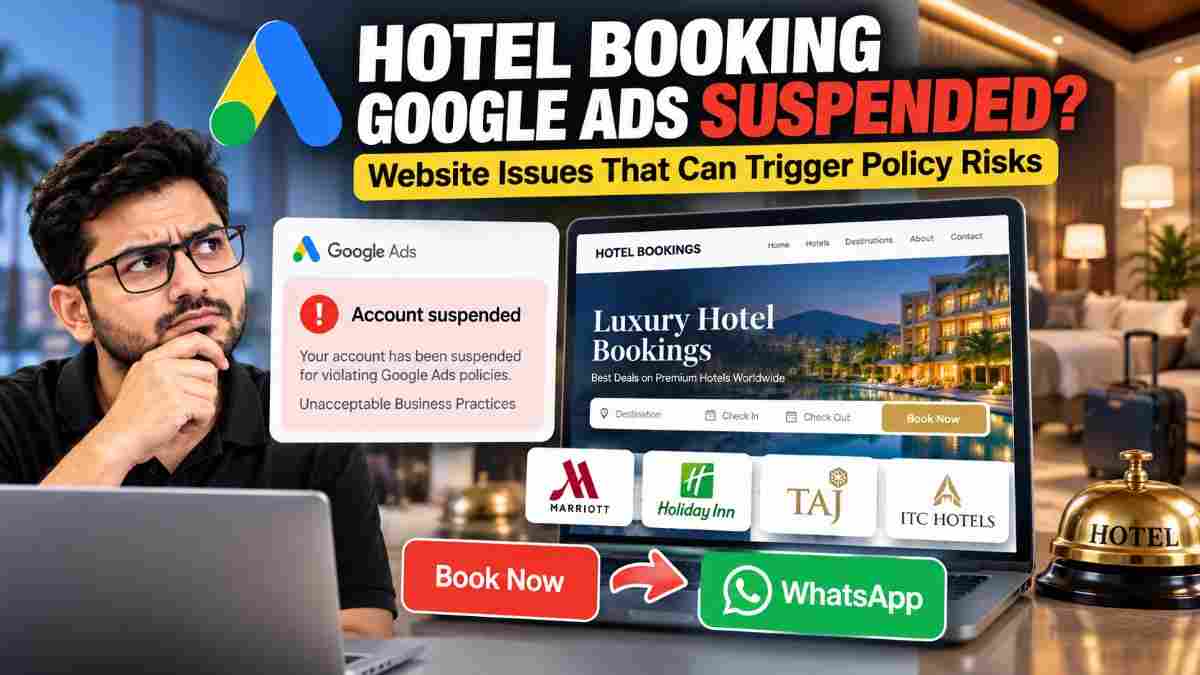
# Google Ads Suspended for Unacceptable Business Practices? A Hotel Booking Website Audit
Running Google Ads for hotel bookings can be a valuable way to generate enquiries and attract customers looking for accommodation. However, advertising hotel reservations comes with an important responsibility: customers must understand which business they are dealing with, what service is being offered, and how the booking process actually works.
Recently, I received an enquiry from a hotel-booking business whose Google Ads account had been suspended under the **Unacceptable Business Practices** policy.
I reviewed the website to identify potential issues that could affect customer trust and create Google Ads policy risks.
During the audit, several areas required attention, including the presentation of well-known hotel brands, unclear business identity, missing contact information, and a booking button that redirected visitors to WhatsApp rather than taking them through a conventional booking process.
This case highlights an important lesson for advertisers: a website should not simply look professional. It should also clearly communicate who operates the business, what customers can expect, and how the advertised service is delivered.
1. What Is the Google Ads Unacceptable Business Practices Policy?
Google Ads has strict policies against misleading users about a business, its products, services, or relationship with another organization.
Under the Unacceptable Business Practices policy, advertisers must not hide or misrepresent material information about their identity, affiliations, qualifications, or ability to deliver the advertised service.
Google may review several sources when evaluating a potential violation, including the advertisement, website, advertising account, and third-party information.
Serious violations of this policy can result in account suspension without prior warning.
For hotel-booking websites, this means the business must clearly explain whether it operates as a travel agency, booking intermediary, hotel representative, or another type of service provider.
The business model should be transparent to customers before they make an enquiry or payment.
2. Listing Well-Known Hotel Brands Without Clear Affiliation Information
One of the first areas I reviewed was how the website presented major hotel brands, including Marriott, Holiday Inn, Taj, and ITC Hotels.
The website featured multiple hotel brands and described the business as an independent partner.
The concern was not simply that these brands appeared on the website. A travel business may legitimately offer bookings at hotels operated by well-known chains.
The important question is whether the website clearly explains the actual relationship between the advertiser and those hotels.
For example, customers should be able to understand whether the business is
- An independent travel agency arranging hotel reservations.
- A third-party booking intermediary.
- An officially authorized booking partner.
- An operator providing another clearly defined accommodation-related service.
These business models are not interchangeable.
If a business is independent, it should not create the impression that it is the official booking website of a hotel chain or an authorized representative without appropriate evidence.
How to fix this issue
Clearly explain the company's role on the website.
If the business operates independently, describe it accurately and clarify that it is not the official website of the listed hotel brands where appropriate.
Only claim official partnerships or authorization when those claims can be substantiated.
Use hotel brand names and logos in accordance with applicable trademark requirements and the relevant brands' usage rules.
**Important:** An independent booking business is not automatically prohibited from advertising hotel reservations. The issue is whether its identity, affiliations, and services are represented honestly.
3. The Book Now Button Redirected Visitors to WhatsApp
Another important issue appeared in the website's customer journey.
When visitors clicked the **Book Now** button, they were redirected to WhatsApp instead of being taken to a booking form or reservation system.
WhatsApp can be a legitimate channel for hotel enquiries. Many businesses use it to discuss availability, room categories, prices, and reservation details.
However, the wording of the button matters.
A visitor clicking Book Now may reasonably expect to complete a reservation or enter a clear booking process. If the button only opens a WhatsApp conversation, the website should communicate that expectation accurately.
What should the website do instead?
There are two practical options.
**Option 1: Use a WhatsApp enquiry button**
If the business handles reservations manually through WhatsApp, use clear wording such as
- Enquire on WhatsApp
- Check Availability on WhatsApp
- Request a Hotel Booking
- Discuss Your Reservation
The WhatsApp conversation should clearly identify the business and explain the next steps.
**Option 2: Implement a genuine booking process**
If the business wants to use a Book Now button, provide a booking experience appropriate to the service being advertised.
This might include selecting a hotel, choosing dates, checking availability, reviewing the price and conditions, and submitting a reservation request.
If the reservation is completed through a third-party booking provider, explain that transition clearly.
The objective is simple: **the action promised by the button should match what happens after the customer clicks it.**
A WhatsApp redirect alone does not prove a policy violation, but unclear or misleading booking claims can contribute to broader concerns about how the service is represented.
4. Missing Contact Details and Unclear Business Identity
Another area that deserved attention was the availability of business information.
When a customer is considering a hotel reservation, they should be able to identify the company handling their enquiry and understand how to contact it.
If important business details are missing or difficult to find, customers may have difficulty verifying who they are dealing with.
A professional hotel-booking website should clearly display relevant information such as
- The actual operating business or legal business name.
- A working contact number.
- A business email address.
- A clear Contact Us page.
- An About Us page explaining the service.
- A business address, where applicable and appropriate.
- Terms and conditions for enquiries and reservations.
- Cancellation, refund, and payment policies where relevant to the booking model.
- A privacy policy explaining how customer information is handled.
The business should provide accurate information appropriate to its legal structure and operating model.
For example, if a sole proprietor operates the business, the website should not invent a corporate identity or imply that it is a hotel chain's official office.
Why does this matter for Google Ads?
Google's Unacceptable Business Practices policy specifically addresses hiding or misrepresenting business information.
Clear contact details and an accurate business description help customers understand who is offering the service.
Adding a phone number or About Us page does not guarantee account reinstatement, but these are important elements to review during a website audit.
5. Unclear Booking Terms, Prices, and Reservation Responsibility
Hotel reservations involve more than generating an enquiry.
Customers may need to know the room price, availability, taxes, cancellation conditions, payment arrangements, and the identity of the party handling the reservation.
If the website advertises hotel bookings but does not explain what happens after a customer enquires, the customer journey may be confusing.
For example
- Does the business confirm availability directly with the hotel?
- Is the customer paying the hotel or an intermediary?
- Who issues the booking confirmation?
- Who handles cancellations or refund requests?
- Are the advertised rates subject to conditions?
The website should answer the relevant questions clearly before customers commit to a booking or payment.
Not every website must display an identical checkout system. The information required depends on the business model. However, customers should not be misled about the service, the booking provider, or the costs involved.
6. Does Redirecting Users to WhatsApp Cause Google Ads Suspension?
This is an important question because many Indian businesses use WhatsApp to handle leads and bookings.
The answer is: **No, a WhatsApp redirect does not automatically mean a Google Ads policy violation.**
A business can use WhatsApp for legitimate customer enquiries, provided that the advertising and destination experience comply with the applicable policies.
The risk depends on the overall context.
For example, a website that clearly identifies its operator, accurately explains its booking service, and uses a button labelled Enquire on WhatsApp provides a different customer experience from a website that implies an official hotel reservation service but sends visitors into an unclear conversation with an unidentified business.
Google also has destination requirements concerning functional landing pages, misleading redirects, destination mismatches, and the usefulness of the destination experience.
However, not every external redirect is prohibited, and WhatsApp should not be treated as the cause of a suspension without evidence.
When an account is suspended for Unacceptable Business Practices, review the complete website, business identity, affiliation claims, advertised services, and customer journey rather than focusing on just one button.
7. Why a Website Audit Is Important Before Running Google Ads
Many advertisers focus only on keywords, bidding strategies, ad headlines, and campaign budgets.
But Google Ads compliance also depends on the business and the destination customers reach.
Before launching a hotel-booking campaign, review the website from the perspective of a first-time customer.
Ask yourself
- Can visitors immediately understand who operates the website?
- Is the business's relationship with each hotel brand explained accurately?
- Are official partnership claims supported by evidence?
- Does each button accurately describe its action?
- Can visitors identify the business and contact it?
- Are the booking process and payment arrangements explained?
- Are relevant terms, privacy information, and cancellation conditions available?
- Does the website deliver the service promised in the advertisement?
These checks can help identify potential trust and compliance issues before they become more serious.
8. How to Approach a Google Ads Account Suspension
If Google Ads suspends an account for Unacceptable Business Practices, do not immediately create another account or repeatedly submit appeals without investigating the underlying issue.
A more careful approach is to
**Step 1: Review the suspension notification.**
Identify the exact policy cited by Google and read the relevant policy requirements.
**Step 2: Audit the complete website.**
Review the homepage, hotel listing pages, booking buttons, contact information, business identity, partnership claims, pricing, and terms.
**Step 3: Verify the business model.**
Document whether the company operates as an independent booking intermediary, travel agency, authorized partner, or another type of service provider.
**Step 4: Correct misleading or incomplete information.**
Make sure the website accurately describes the business and the services it can deliver. Correct misleading button labels and clarify the booking process.
**Step 5: Collect supporting evidence.**
Where relevant, gather business documentation, authorization agreements, and other evidence that supports the claims made on the website.
**Step 6: Submit a truthful, evidence-based appeal.**
Explain the actual business model, the changes made, and the evidence supporting compliance. An appeal should address the real concerns rather than simply state that the business is genuine.
Google treats Unacceptable Business Practices violations seriously. Correcting a website does not guarantee reinstatement, and the appeal should never include claims that cannot be verified.
Final Thoughts
This hotel-booking website audit highlights why Google Ads compliance requires more than a well-designed website and an active campaign.
A business may offer legitimate hotel-booking assistance, but it still needs to represent its identity, relationships with hotel brands, and booking process accurately.
In this case, the key areas identified for review included unclear hotel-brand affiliations, missing business and contact information, and Book Now buttons that redirected visitors to WhatsApp without providing the expected booking experience.
These findings represented potential policy risks that needed to be investigated and corrected. They should not be treated as individually confirmed causes of the account suspension unless Google's review or other reliable evidence establishes that connection.
If you advertise hotel bookings, travel services, or other third-party products and services, review your website carefully before launching a campaign.
**Need help reviewing your Google Ads account or website for potential policy issues?**
Visit [YashDeliwala.com](https://www.yashdeliwala.com/) to learn more about Google Ads management and advertising support.
*Disclaimer: This article is for educational purposes. It describes a website audit and potential policy risks, not a confirmed determination of Google's internal suspension decision. Google makes its own policy enforcement and account reinstatement decisions.*

Yash Deliwala
Google Ads Freelancer and PPC Consultant based in India. Specializing in high-intent Search campaigns, Performance Max, lead generation, and conversion tracking for businesses across India.
Want to Scale Your Business with Google Ads?
Get direct campaign planning, Search ad setup, and lead optimization with Yash Deliwala.
Chat with Yash on WhatsApp